Steam
What is that hissing noise?
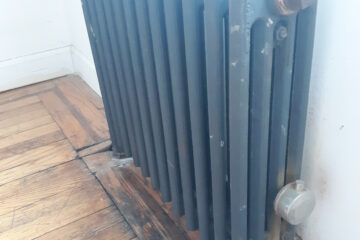
Perhaps the most common question I get from apartment dwellers in NYC is “what is that hissing noise?”. The “hissing noise” that you hear in a 1-pipe steam heated space is the air vent letting Read more…

Existing buildings must strike a balance between “too much” and “not enough” as they operate. Improvements to energy performance are most effective when the solution includes striving without over-extending.

There are many different ways that the latest technology and improvements to controls can be applied to existing buildings. The best strategies to improve performance often include creative adaptation.
Benjamin is a Professional Engineer and has spent the last 15 years working in buildings and campuses throughout New York State. Benjamin is a Certified Energy Manager, a Building Energy Assessment Professional, a Building Commissioning Professional, and has helped develop ASHRAE Standard 211. Benjamin is especially skilled at applying the knowledge gained from retro-commissioning process to the development of project work. Benjamin is a facilitator and a team player.

An Energy Audit (EA) identifies energy conservation measures (ECMs) that, if implemented, would improve energy performance at a building. Owners often use an energy audit as a starting point to develop the project work required to improve their energy performance. ASHRAE Level 2 Energy Audits typically include No-Cost and Low-Cost opportunities as well as Capital Projects that may require design work or other planning prior to implementing. A great energy audit will lead to action that results in the Owner meeting their energy performance targets.

Existing Building Commissioning or Retro-Commissioning (RCx) is the process of ensuring that operational procedures are meeting the Current Facility Requirements at a building. RCx typically includes functional performance tests on the equipment in the building. RCx will sometimes reveal operational issues that, when corrected, result in significant improvements to energy performance. It is recommended that most buildings undergo RCx every 10 years at a minimum, or have a process in place that ensures that RCx is occuring on an ongoing basis.

Local Law 97 essentially goes into effect on January 1, 2024, and requires that an annual building emissions report be filed to the Department of Buildings starting May 1st, 2025, and by May 1 of every year thereafter. The annual reports must be certified by a Registered Design Professional. Penalties may be assessed to buildings that exceed their allocated building emissions limit. Additionally, Article 321 of Local Law 97 requires that a report be filed by May 1st, 2025 that includes a list of all equipment at the building as well as verification that a list of 13 prescriptive energy conservation measures has been implemented.
Perhaps the most common question I get from apartment dwellers in NYC is “what is that hissing noise?”. The “hissing noise” that you hear in a 1-pipe steam heated space is the air vent letting Read more…
+1 917 730 4947 Mon – Fri, 9:00-18:00